The D-70, known by its factory index as "Object 20" formally entered service in Dosland's army on the 5th of February, 1969. The tank was designed by the OKB-710 bureau, lead by Aleksandr Putyinov and built at Tabrinskiavtozavod. The D-70 remains in service until today, still being maintained by Tabrinskiavotzavod(TAZ), despite production ending in 1992
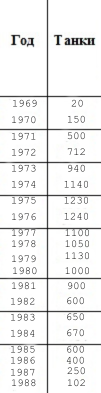
In total between the years 1969-1988, 14,284 "D-70" models of all variants were built, making it among the most produced tanks in the world, narrowly beating the D-50.
The D-70 was since its inception, intended to be the primary MBT of Doslands armoured formations, and would form the bulk of tanks present in the Zavodski theatre. First reaching the 1st tank army in November of 1969, with the 14th Guards Tank Division, 164th Guards Tank Regiment being the first to recieve them, with testing beginning immediately. Although being an incredibly new design, first impressions were generally positive. A memoir written by Lieutenant Daviskyii Sokolov reads the following:
A severe drawback seen in numerous letterings is the loss of the 4th crew member. With an incredibly complex machine, even 4 on maintainence would have been precarious, the situation with 3 would be unmaintainable.
The history of the D-70 starts further back, with its precursor the Object 196. On April 23rd 1966, Minister of the Interior Department of Military Affairs issued directive "126.493A", and work begun being drafted in numerous design bureaus across Dosland. This directive led to numerous other designs, such as Object 714 and Object 470, however Object 196 was the most influential in relation to the D-70. Object 196 was designed by the OKB-550 bureau, who was lead by the known designer Anton Orlov. Intended to be a sort of "super D-50", the Object 196 can be further traced back to experimentation on the Object 19 design, mock-up pictured below.
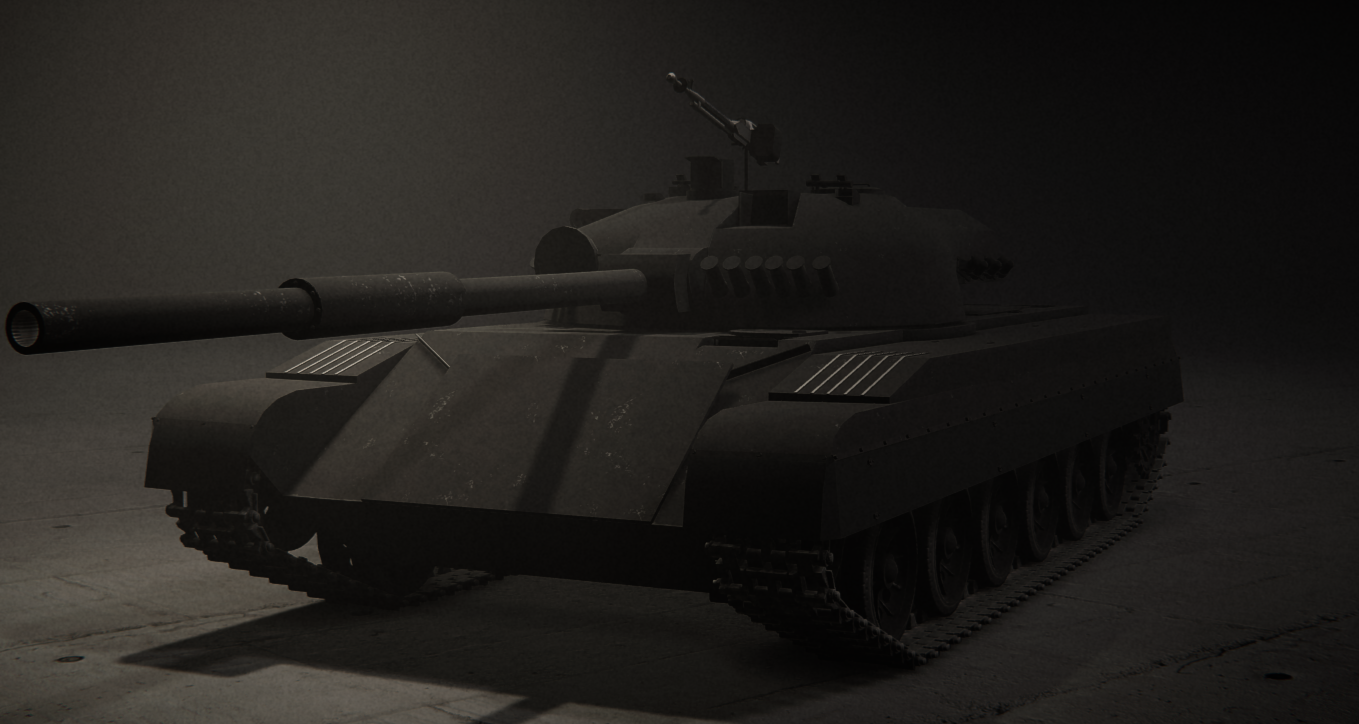
The object 196 featured a new turret with a bustle-style autoloader, the 115mm A-62T cannon, a V-42 engine producing 700hp, a new transmission, and a new suspension system. The new turret housed the TGDN-4 gunner sight, and the TCMS-2 commanders optic. It utilised the new "Razvedka" fire control system, with the 2E15 "Zhelti" duel-axis stabiliser which would lay the groundwork for the D-70's own fire control systems.
The evolution of the D-70 was incredibly complex, but will be condensed into the main variants
The original production model, with A-62M, TGDN-4, TCMS-2, A-64 and no dynamic armour. Very limited production run, with only 170 units produced.
The first true D-70 model, with Tochki-1 dynamic armour.
Following demands by the Ministry of Defence to bring the D-70 platform into the new decade. Revised hull composite with additional 30mm plate, Tochki-4 dynamic protection, A-64M, 1A35, and TCMS-3.
Intially intended for export before entering service, it is a substantial upgrade over previous models. New welded composite package over the turret front with dynamic protection and the new Shtora-1M system. A composite package over the UFP with dynamic protection overtop. A-64M-2, 1A35M-2, TCMS-3M
In terms of ergonomics, the D-70 was vastly superior to that of the D-50 and D-56, and on par with contemporary tanks. With increased height to accommodate the new bustle autoloader, the turret crew get vastly more vertical space, to which even a man of tall stature could fit.
 Home
Home